 Book
Book 


Articles
April 29, 2026
The best moments of the winter season
The sun is warming the fir trees. The snow is melting, giving way to flowering pastu…
Do you think you are alone on the walking paths? Think again!
Whether it’s a curious whistle from behind a rock or a shadow passing slowly above your head, the valley is teeming with curious creatures, both large and small, who are watching you long before you spot them. Some encounters are almost guaranteed – like a welcome gift from the mountains – whilst others have to be earned and require a little patience and discretion.
And then there are the valley’s most secretive creatures – those you might only catch a glimpse of once in a lifetime, if luck is on your side. To help you, Thibaut, our nature guide with a passion for birdwatching, offers some valuable tips throughout this article. We’ll take you to meet our local stars, from the easiest to spot to the most elusive.
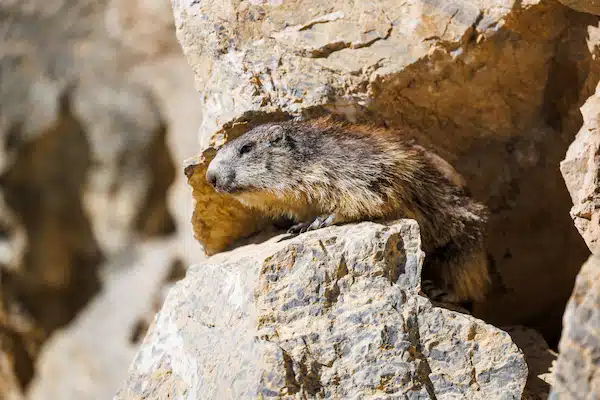
You can’t mistake a marmot, its high-pitched whistle cutting through the air; perched like a sentinel on its rock, warning the colony that an intruder is approaching. A living emblem of Savoie, a marmot is fairly easy to spot, often basking in the sun before darting back into its burrow at the slightest sudden movement.
Morning and late afternoon are its favourite times of day, when the heat is less intense and he can venture out without becoming fatigued. The colonies around Lac Tuéda and on the Plagne plateau are particularly active; if you stop for a few minutes in silence you are likely to see several of them pop their heads out.
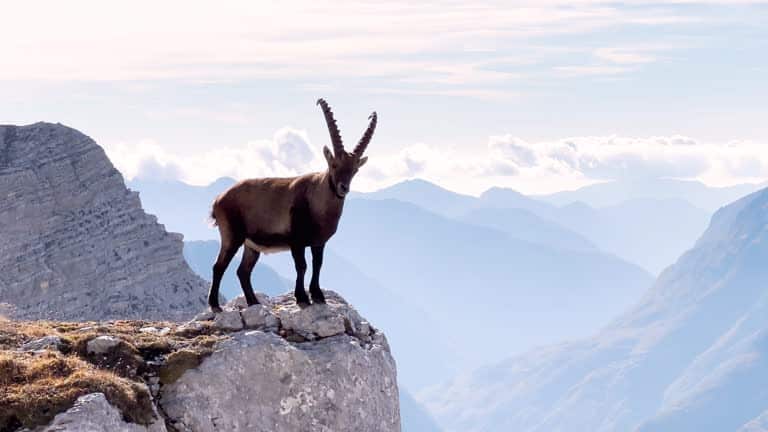
You’ll need to hike a little to find these mountain goats, but once you’re high up, if you look in the right places, one may well appear! Head for the Gébroulaz glacier or the area around the Saut refuge, where chamois and ibex roam the same slopes.
Point your binoculars towards the rocky areas, ridges and boulder fields; you’ll recognise an ibex by its massive horns curving backwards, moving with ease across vertiginous slopes. Once spotted, it proves surprisingly tolerant of human presence, provided you keep your distance and remain quiet.

Rarely seen in broad daylight, a fox is more likely to show itself at dusk, when the valley quietens down and it begins to hunt. Contrary to its reputation as a wary animal, Méribel’s foxes are unlikely to bolt at the slightest noise, but you still need to be in the right place at the right time – mostly a matter of patience and luck.
If you hope to see one hunting, it’s best to wait until the dead of night when the forest is silent. With your ears pricked, your chances of catching it in action increase significantly.

Recognisable by the golden hue of its adult plumage, this bird’s name in French is the ‘royal eagle’ and it was a symbol of both gods and empires in ancient times. It remains a familiar sight above Méribel, with around twenty pairs continuing to reign over the skies of the Vanoise. Unlike the rare bearded vulture, the golden eagle can often be seen: on fine days, it’s not uncommon to see them soaring high in the sky, silently using updrafts to conserve energy.
From December to March, the mating season even offers a rare spectacle. The pairs perform a series of synchronised flights, soaring and diving together in a choreographed display that is hard to spot, but well worth every minute spent waiting with your neck craned upwards.

Black grouse owes their beauty to their bluish-black plumage and their tail which curves like a lyre. They prefer the upper forest boundaries, between 1,400 and 2,300m, the transitional zone where alpine meadows and sparse woodland meet. To spot one, you need to look above the lake – Thibaut informs us that the black grouse is a species found only in la Réserve de Tuéda.
For much of the year, it remains shy and difficult to approach, but in spring the males gather at their ‘lekking grounds’ for a spectacular display, shaking their tails to the rhythm of their burbling song.

Unlike ibex, chamois have short, hook-shaped horns and a coat that darkens in winter. Although found throughout the valley, they remain elusive creatures. They move between the forests and the high mountains depending on the season and their needs and whims.
Here, it’s best to set out early in the morning, when they are most active before the heat drives them into the shade. The best time to spot them is October and November, the rutting season, when the males engage in spectacular duels to impress the females.
To try your luck, head to Pralognan-la-Vanoise, where guided tours regularly take visitors to the Col d’Aiguille or Lac de l’Observatoire in search of the herds.

With a wingspan of 2.80m, a diamond-shaped tail and its famous beard, the bearded vulture certainly makes an impression when it chooses to show itself. Long persecuted and on the brink of extinction in the Alps, it owes its current presence to a reintroduction programme launched in the 1980s, though the population remains vulnerable to this day.
Spotting one in Méribel is, as Thibaut confirms, a matter of luck. It nests on cliffs and may have up to eight different nesting sites across a territory of several hundred square kilometres, changing its nest from one year to the next. Suffice to say that an encounter with this majestic bird is a memory to treasure – it’s a rare occurrence.

Immaculately white in winter, mottled brown in summer, this member of the grouse family changes its attire with the seasons to blend into its surroundings. As a result, whatever the season, it generally goes completely unnoticed, even right under your nose.
It is certainly present in Méribel, but you’ll need to climb to higher altitudes to stand any chance of spotting it; it can be found at altitudes ranging from around 2,500m to 3,000m.
Once up there, you’ll still need a trained eye or a lot of luck to spot one.
“The advantage of the Tuéda Reserve is that you’re already quite high up. It’s easier to spot golden eagles and, if you climb higher still, ptarmigans and other high mountain species …”

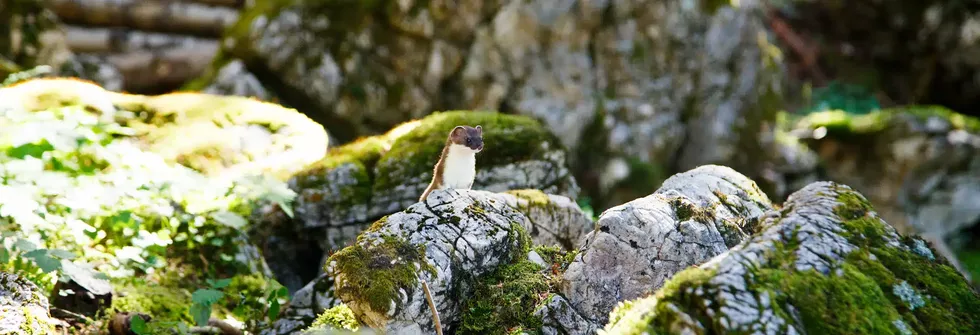
You could spend years hiking in the Vanoise without ever spotting a stoat. Tiny, swift, and capable of changing colour with the seasons – white in winter to disappear into the snow, brown in summer to blend into the scree – it is a true mountain chameleon.
It nests amongst scree, hunts at night in winter and by day in summer, and can cover up to 15km in a single night in pursuit of voles, which makes it even harder to spot.
So if you haven’t managed to spot one by the end of your holiday, don’t blame your powers of observation; it’s simply that the stoat is like a ghost, and far more skilled than we are at the game of hide-and-seek.

It is said that an animal even more elusive than the stoat roams our mountains. Half chamois, half ibex, with legs shorter on one side than the other, designed to traverse the slopes without ever falling over – provided it never turns around.
No one has ever actually seen it, but everyone knows someone who knows someone who swears they’ve come across it…
The best moments of the winter season
The sun is warming the fir trees. The snow is melting, giving way to flowering pastu…
A ski holiday in the heart of Les 3 Vallées
Welcome to the heart of the world’s largest ski area!

The Art of Après-Ski in Méribel
The day is drawing to a close, the sun is setting behind the ridge and you have disc…
A relaxing break in Méribel
Winter in the mountains isn't only about hurtling down the slopes!